


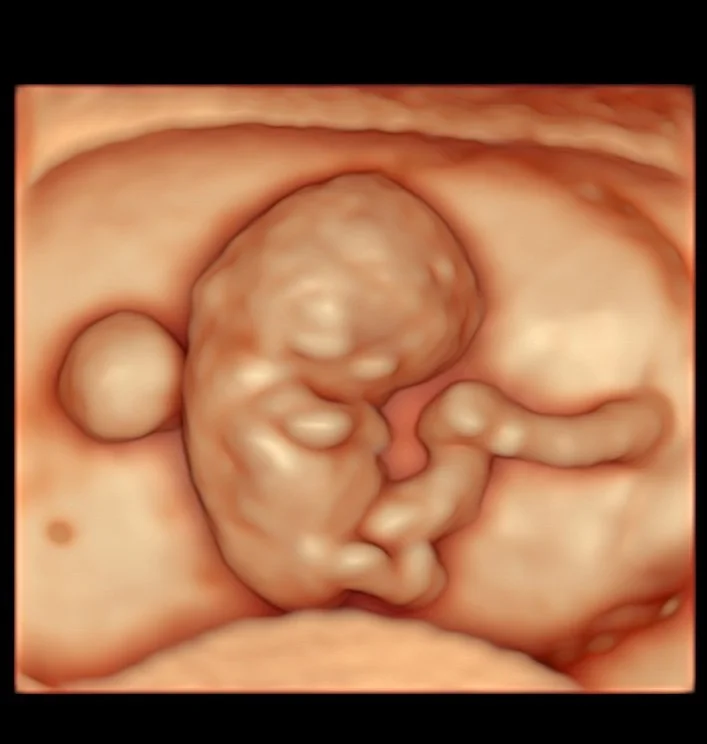
There’s a particular kind of quiet that falls over a room the moment a baby’s face appears on an ultrasound screen. Conversations pause. Someone usually laughs or tears up. It becomes one of those moments families remember long after the appointment. It’s a small moment, technically speaking just sound waves converted into an image, but it often marks the point where a pregnancy stops feeling abstract and starts feeling like a person.
That shift matters more than it might seem. Attachment research has long pointed to prenatal bonding as a meaningful part of the transition into parenthood, and modern imaging has given families new ways to experience it earlier and more vividly than ultrasound technology once allowed.
From Grainy Outlines to Recognisable Faces
Ultrasound has existed in clinical settings for decades, but early machines produced flat, two-dimensional images that took real skill to interpret. Parents often needed a sonographer to point out where the head, spine, or limbs actually were. It was informative, but rarely emotional in the way a photograph is.
The shift to 3D rendering changed that. By reconstructing surface detail from the same sound-wave data, 3D imaging turns a cross-sectional scan into something that looks like an actual face. Add 4D, which captures movement in real time, and suddenly parents are watching their baby yawn, stretch, or turn, not just seeing a still frame.
This progression is central to why early bonding ultrasound appointments in Perth have grown so popular. They give parents something a standard clinical scan usually doesn’t: a moment that feels personal rather than purely diagnostic.
Why Seeing Movement Changes the Experience
Static images are meaningful, but there’s something different about watching a baby move in real time. Parents frequently describe the moment a baby’s hand drifts toward its face, or its mouth opens in a yawn, as the point where the pregnancy became “real” to them in a way weeks of appointments hadn’t quite managed.
This isn’t just anecdotal. Developmental psychologists studying prenatal attachment have noted that visual and sensory experiences, seeing movement, hearing a heartbeat, tend to strengthen the emotional connection parents form before birth. Modern 4D imaging taps directly into that.
A Moment Partners Can Share Equally
Pregnancy naturally centres around the person carrying the baby, who feels movement and physical changes directly. Partners often describe feeling somewhat outside that experience, aware of the pregnancy intellectually but not always connected to it emotionally in the same way.
An ultrasound appointment changes that dynamic, if only briefly. Everyone in the room sees the same image at the same time. It’s one of the few pregnancy milestones that partners can experience as directly as the person carrying the baby, which is part of why so many studios now design their spaces to comfortably include both parents, and often extended family, in the room.
Keepsake Imaging as More Than a Souvenir
Some parents view premium 3D/4D/5D keepsake imaging services in Perth as simply a nice photo to keep. For many, though, the value runs deeper. A printed image or short video becomes something they return to throughout the pregnancy, and later, something they show their child years afterward. It’s a tangible artifact of a relationship that began before birth.
Providers such as Amara Imaging have built much of their appointment experience around this idea, treating the scan as a meaningful keepsake moment rather than a purely technical procedure.
What This Technology Can’t Replace
It’s worth being clear-eyed about the limits here. Elective 3D/4D/5D ultrasound Perth scans are non-diagnostic. They’re designed for connection and reassurance, not to replace the anatomy scans and clinical monitoring that remain essential parts of prenatal care. A qualified sonographer performing an elective scan will always be transparent about that distinction, offering a warm experience without overstating what the imaging shows.
Bonding through technology is a complement to, not a substitute for, the relationship parents build through the everyday realities of pregnancy: feeling movement, talking to the bump, preparing a nursery, imagining names.
Where This Leaves Expecting Parents
Modern ultrasound imaging hasn’t changed what pregnancy fundamentally is, but it has changed how early and how vividly parents can connect with the person growing inside. A face on a screen, a yawn caught mid-motion, a hand curling near a cheek: these moments don’t replace the months of anticipation that follow, but they do give that anticipation a shape. For many families, that’s exactly the point.
