


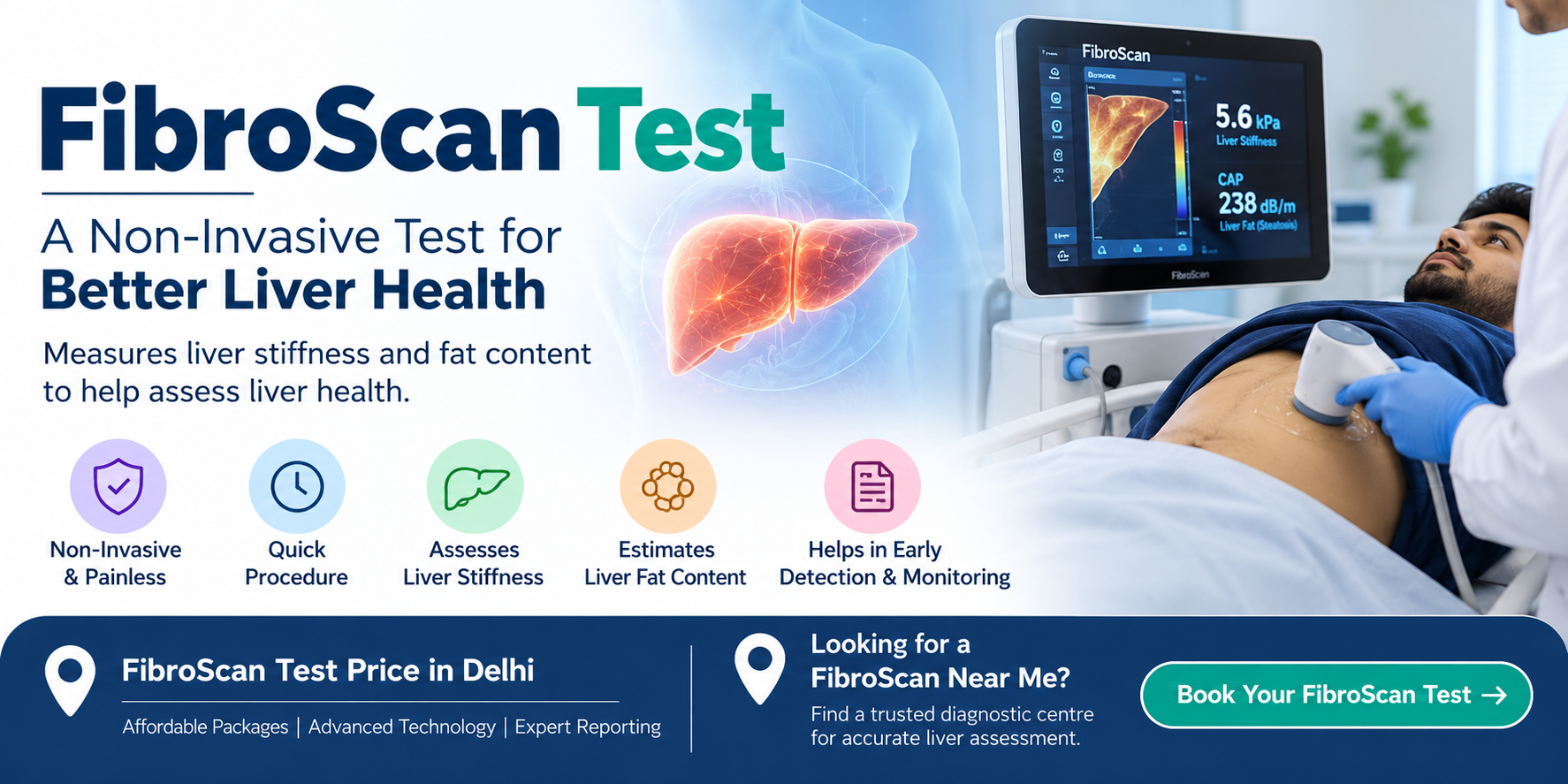
Liver health plays an important role in overall well-being, but liver problems may develop without noticeable symptoms during the early stages. A FibroScan test is a non-invasive diagnostic test that helps assess liver stiffness and estimate liver fat content. Doctors may recommend this test when evaluating conditions such as fatty liver disease, chronic hepatitis, or suspected liver fibrosis.
Unlike a traditional liver biopsy, FibroScan does not require a needle to collect liver tissue. It uses specialised ultrasound-based technology to measure how stiff the liver is and, depending on the device, estimate fat accumulation.
For people searching online for the FibroScan test price in Delhi, understanding the procedure, its benefits, and when it may be needed can help them make informed decisions about liver health.
What Is a FibroScan Test?
FibroScan is a non-invasive examination that uses transient elastography to assess liver stiffness. Liver stiffness measurements can help doctors evaluate the possibility of fibrosis, which occurs when scar tissue develops in the liver.
Many FibroScan devices also provide a controlled attenuation parameter (CAP) measurement, which helps estimate fat accumulation in the liver.
The test is commonly used as part of the assessment of people with fatty liver disease, chronic viral hepatitis, and other liver conditions. Doctors interpret the findings alongside medical history, blood tests, imaging results, and other relevant clinical information.
A FibroScan result alone does not establish every liver diagnosis or determine the exact cause of liver damage.
Why Do Doctors Recommend a FibroScan Test?
Doctors may recommend FibroScan when they need additional information about liver stiffness or fat accumulation. The test can support the assessment and monitoring of certain liver conditions.
Common reasons include:
1. Assessment of Fatty Liver Disease
Fat accumulation in the liver can occur due to metabolic factors, alcohol consumption, and other causes. FibroScan may help estimate liver fat and assess whether significant liver stiffness is also present.
2. Evaluation of Liver Fibrosis
Persistent liver injury can lead to fibrosis, in which scar tissue develops over time. Measuring liver stiffness can help doctors assess the likelihood of fibrosis and determine whether further evaluation is necessary.
3. Monitoring Chronic Liver Conditions
People with chronic hepatitis or other long-term liver conditions may undergo FibroScan as part of their follow-up care. Comparing results over time may help clinicians assess changes in liver stiffness.
4. Assessment of Liver Health in People With Metabolic Risk Factors
People with diabetes, obesity, or certain metabolic conditions may have an increased risk of fatty liver disease. A doctor may recommend FibroScan when the person’s history, examination, or initial test results indicate that further assessment is appropriate.
Not everyone with these risk factors needs a FibroScan. The decision depends on individual clinical circumstances.
How Is a FibroScan Test Performed?
A FibroScan examination is generally quick and straightforward. It is usually performed on an outpatient basis and does not require surgery or anaesthesia.
The procedure typically involves the following steps:
Step 1: Preparation and positioning
The patient may be asked to lie on their back with the right arm raised above the head. This position helps the healthcare professional access the appropriate area over the liver.
Step 2: Applying ultrasound gel
A small amount of gel is applied to the skin over the liver area to facilitate contact with the probe.
Step 3: Taking measurements
The operator places the probe against the skin and obtains a series of measurements. The device sends mechanical vibrations into the liver and measures how quickly the resulting waves travel through the tissue.
Step 4: Reviewing the results
The machine generates measurements related to liver stiffness and, when supported by the device, liver fat estimation. A qualified healthcare professional interprets the results in the context of the patient’s medical history and other investigations.
The examination is generally painless. Some people may feel slight pressure from the probe, but there is usually no significant discomfort.
What Is the FibroScan Test Price in Delhi?
The FibroScan test price in Delhi can vary between diagnostic centres. The final cost may depend on the equipment available, the services included, the location of the centre, and the reporting arrangements.
When comparing prices, patients should confirm whether the quoted amount includes the complete examination, the liver stiffness measurement, the fat assessment where available, and the final report.
Before booking, consider asking the diagnostic centre:
- What is the current price of the FibroScan test?
- Does the examination include both liver stiffness and liver fat assessment?
- Is a doctor’s consultation included in the quoted price?
- How long will it take to receive the report?
- Is an appointment required, and what preparation instructions should be followed?
It is best to confirm the current price directly with the diagnostic centre because advertised prices and service inclusions can change.
How to Find a FibroScan Near Me
If your doctor has recommended liver stiffness assessment, searching for a FibroScan near me can help you identify diagnostic centres that offer the test in your area.
However, choosing a centre involves more than finding the nearest location or the lowest advertised price.
Consider the following factors before booking:
Availability of suitable equipment: Confirm that the centre offers FibroScan or an appropriate transient elastography service for your clinical requirement.
Qualified staff: Ask whether trained personnel perform the examination and whether the results are reviewed by an appropriately qualified healthcare professional.
Transparent pricing: Check what is included in the total price and whether any additional charges apply.
Convenient location: Consider travel time, appointment availability, and accessibility, especially if you need follow-up examinations.
Clear reporting: Choose a centre that provides understandable reports and allows your treating doctor to review the results.
You can search by your neighbourhood or PIN code, check the diagnostic centre’s service information, and contact the centre directly to confirm availability.
If you are looking for a FibroScan test in Delhi, contacting an established diagnostic provider can help you understand the available options and arrange an appointment according to your doctor’s recommendation.
How Should You Prepare for a FibroScan Test?
Preparation requirements can vary according to the diagnostic centre and the equipment used. Patients are commonly advised to fast for a period before the examination because recent food intake may affect liver stiffness measurements.
Follow the specific fasting instructions provided by your diagnostic centre. Do not stop prescribed medicines unless your doctor advises you to do so.
Before the appointment:
- Confirm how long you need to fast.
- Inform the staff about your medical history and any relevant previous liver investigations.
- Bring previous reports if available.
- Tell the healthcare professional if you are pregnant or have any implanted medical device or other condition that may affect test selection.
- Ask whether any additional preparation is required.
Following the centre’s instructions helps the operator obtain measurements that can be interpreted appropriately.
FibroScan vs. Liver Biopsy: What Is the Difference?
FibroScan and liver biopsy provide different types of information about liver health.
| Feature | FibroScan | Liver biopsy |
|---|---|---|
| Method | Non-invasive measurement using transient elastography | A small liver tissue sample is collected using a needle or another biopsy technique |
| Main purpose | Assesses liver stiffness and may estimate liver fat | Examines liver tissue under a microscope |
| Recovery | Usually no recovery period is needed | Observation or recovery may be required |
| Risks | Generally low, with no needle-related injury | Involves procedural risks, including bleeding and pain |
| Limitations | Does not directly examine liver tissue | Invasive and may not represent every part of the liver |
FibroScan can reduce the need for biopsy in some clinical situations, but it does not replace biopsy in every case. A doctor may recommend further testing when the results are unclear or when a tissue diagnosis is needed.
Can FibroScan Detect Fatty Liver and Liver Damage?
FibroScan can help assess liver stiffness and, with appropriate equipment, estimate liver fat. These measurements provide useful information when investigating certain liver conditions.
However, the test has limitations. Liver stiffness can be influenced by factors other than fibrosis, including active liver inflammation, bile flow obstruction, and congestion. The accuracy of measurements can also be affected by technical factors.
FibroScan does not independently identify every cause of liver disease or reliably rule out all liver complications. Doctors may combine the results with liver function tests, platelet counts, other blood tests, ultrasound examinations, and clinical assessment.
If your report shows abnormal measurements, discuss the findings with your doctor rather than interpreting the numbers in isolation.
When Should You Consider a Liver Health Assessment?
You should consult a healthcare professional if you have persistent concerns about liver health, abnormal liver blood test results, a history of chronic hepatitis, or risk factors associated with fatty liver disease.
Symptoms such as yellowing of the skin or eyes, abdominal swelling, unexplained persistent fatigue, or dark urine require appropriate medical assessment. These symptoms do not automatically mean you need a FibroScan; your doctor will determine the most suitable investigations.
Early evaluation can help identify underlying problems and guide appropriate monitoring or treatment.
Conclusion
FibroScan is a useful non-invasive tool for assessing liver stiffness and estimating liver fat. It can support the evaluation of fatty liver disease, liver fibrosis, and certain chronic liver conditions when used alongside medical assessment and other investigations.
If you are comparing the FibroScan test price in Delhi or searching for a FibroScan near me, confirm the current cost, test availability, preparation requirements, and reporting process before booking. Most importantly, discuss your results with a qualified healthcare professional who can interpret them in the context of your overall liver health.
Taking the right steps towards liver assessment can help you and your doctor make informed decisions about further testing, treatment, and follow-up care.
Frequently Asked Questions
1. Is the FibroScan test painful?
No. FibroScan is generally painless and non-invasive. The operator places a probe against the skin over the liver area to obtain measurements.
2. How long does a FibroScan test take?
The examination itself often takes around 5–15 minutes, although the total appointment time may be longer depending on preparation and the centre’s procedures.
3. What is the FibroScan test price in Delhi?
The cost varies by diagnostic centre, equipment, and included services. Contact the centre directly to confirm the current price and whether the test includes liver stiffness and fat assessment.
4. Do I need to fast before a FibroScan?
Fasting is commonly recommended before the examination. Follow the exact fasting duration provided by your diagnostic centre.
5. Can FibroScan detect fatty liver?
FibroScan devices with CAP measurement can estimate liver fat. The findings should be interpreted alongside other clinical information and investigations.
6. Is FibroScan better than an ultrasound?
Both tests provide different information. A conventional ultrasound can show liver appearance and certain structural abnormalities, while FibroScan measures liver stiffness and may estimate fat content. Your doctor will determine which test or combination of tests is appropriate.
7. How can I find a FibroScan near me?
Search for FibroScan or transient elastography services in your locality, check the centre’s service details, and contact it to confirm availability, pricing, and appointment requirements.
8. Does an abnormal FibroScan result mean I have cirrhosis?
Not necessarily. Elevated liver stiffness can have several causes, and the result must be interpreted using appropriate clinical thresholds and other findings. Your doctor may recommend additional investigations to establish the diagnosis.
9. Can FibroScan replace a liver biopsy?
In some situations, FibroScan provides sufficient non-invasive information, but it cannot replace a biopsy in every case. The decision depends on the clinical question and the other available findings.
